"Wetlands and Traditional Knowledge: Celebrating Cultural Heritage"
IWLA Director's Statement Commemorating World Wetlands Day 2026
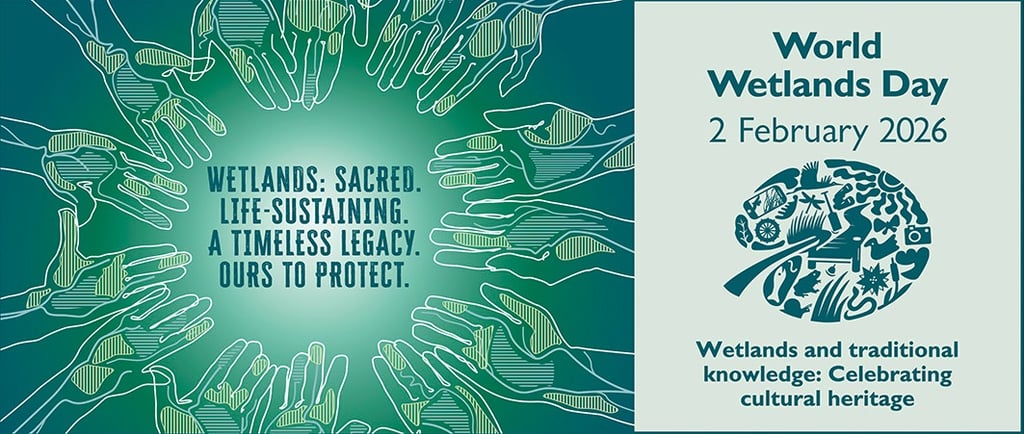
Today is World Wetlands Day, the 55th anniversary of the adoption of the Convention on Wetlands of International Importance especially as Waterfowl Habitat – the RAMSAR Convention - on 2 February 1971, in the Iranian city of Ramsar. The theme of World Wetlands Day 2026, "Wetlands and traditional knowledge: Celebrating cultural heritage", highlights the deep connection between wetlands and traditional knowledge of communities across the world. The Convention provides a cooperative framework for the protection of wetlands around the world, providing them with a special designation. There are over 2,500 Ramsar Sites on the territories of 172 Contracting Parties across the world, covering almost 2.5 million square kilometres, the largest network of protected areas. The United Kingdom and Mexico have the most Ramsar Sites, with 176 and 144 respectively, while Brazil has the largest protected area (267 000km2). Wetlands are of the utmost importance for the livelihood of billions of people, are the home and breeding ground for numerous species, and are vital providers of ecosystem services including flood control and water purification. Despite their importance, 22% of global wetlands have disappeared since 1970, and 25% of remaining wetlands are in poor condition. Without urgent action, the world risks losing the priceless services these ecosystems provide for people, nature, and climate.
The RAMSAR Convention is one of several international instruments that govern transboundary freshwater resources, exhibiting overlapping scope and normative coherence with both the 1997 Convention on the Non-navigational Uses of International Watercourses and the 1992 Convention on the Protection and Use of Transboundary Watercourses and International Lakes. With an emerging “ecosystems approach” across these regimes, further synergies can be found. The International Water Law Academy joins in the celebrations today to support local communities in using their traditional knowledge to protect this vital resource on which they rely for food and their livelihoods. Strengthening these knowledge systems—and embedding them into national and transboundary water policy—is essential to halting wetland loss and securing this vital resource for future generations.
David J Devlaeminck
Director of the International Water Law Academy
djdevlaeminck@live.com
Contact the Academy
Reach out to us anytime for expert guidance anytime, ideas for collaboration and more!
© 2026. All rights reserved.
International Water Law Academy
Academic Excellence,
Professional Relevance